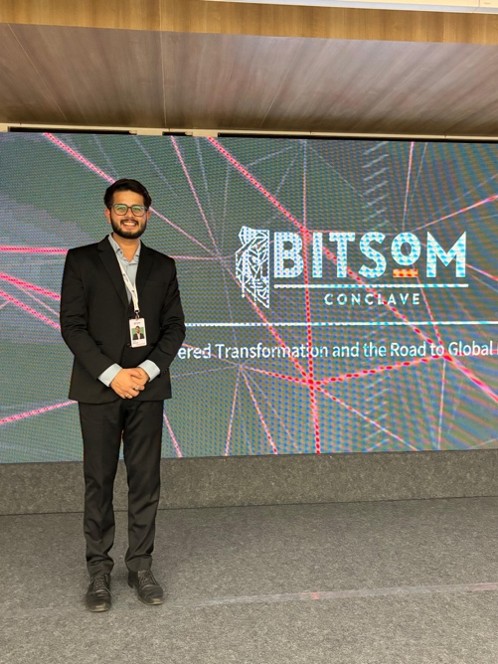
It was an absolute delight to host Dr Nirmalya Kumar, for a friendly Fireside Chat with our Dean, Dr Ranjan Banerjee. Dr Kumar is a Professor of Marketing at the Lee Kong Chian School of Business at Singapore Management University and a distinguished fellow at the INSEAD Emerging Markets Institute. He teaches Advanced Marketing Strategy at BITSoM.
The fascinating conversation yielded some thought-provoking insights.
Counter Cyclical Marketing
The concept came up while addressing the question “What good marketers do during a recession?”
Most organizations budget their marketing costs as a proportion of sales. When markets are good and the potential for sales is high, corporations allocate a larger chunk of money to their marketing budget. But during a recession, corporations go on a diet and reduce their marketing expenditure. The pandemic saw a significant cut in marketing budgets across industries driven by the decrease in consumer spending. This raised alarm bells among marketing executives who began to wonder if this trend would have far-reaching implications beyond the pandemic.
However, according to Professor Kumar, the pandemic was a significant accelerator to certain types of marketing activity. Some businesses choose to keep up their marketing spending and, in some cases, even boost their efforts to enhance visibility. This is referred to as counter-cyclical marketing. Counter-cyclical marketing allows companies to take advantage of lower advertising costs and the sparse visibility of competitors during a recession.
According to research by Professor Kumar, companies who kept up their marketing efforts during the pandemic actually did better in terms of sales and brand visibility. But there are exceptions. Companies promoting travel and outdoor recreation were unlikely to profit from advertising during the pandemic since there was no call to action until restrictions were eased.
Another interesting observation was that large family-run firms were unlikely to cut back on advertising during a crisis. Part of this might be attributed to a personal reputation at risk and the need to maintain credibility.
First People Forward & Revenge Consumption
Dr Kumar explained how shopping helps people deal with their negative emotions. Individuals respond to harsh consumption limits by engaging in “revenge consumption” in order to compensate for the experience of deprivation.
This response assumes a spree of conspicuous consumption and the accumulation of commodities, in an effort to return to the “old normal”. Firms that are likely to be among the first to increase their marketing efforts will be able to profit from the phenomena of revenge consumption. And, true to the phenomenon, there was a surge in travel and tourism following the ease of restrictions.
Social Proof & The Bandwagon Effect
In response to a comment about e-commerce and delivery apps, Dr Kumar spoke about how food delivery services faced an unusual challenge during the pandemic. While customers were enthusiastic about ordering in, they were hesitant about coming in contact with delivery partners fearing a spread of the virus. According to one of the major Indian food delivery startups, demonstrating social proof was a way to engage customers and build confidence.
Social proof is the evidence that other people have purchased and found value in a company’s product or service. Telling customers that sales in Mumbai went up by 30% was not as effective as telling them that three people in their building had recently ordered food through the app. This resulted in a bandwagon effect, where people were willing to use food delivery services merely because they saw their neighbors doing the same.
Building Global Brands out of India
When asked why India was struggling to build aspirational global brands despite the concentration of new businesses emerging in the country, Professor Kumar was frank in his response. According to him, building a global brand out of a developing economy is a challenging task. There are three things we would first need to do:
Find what is unique to us and makes us different.
Make sure that uniqueness is a meaningful differentiator for the customer.
Ensure that differentiated value is perceived by the customer.
He also added that we don’t have a national strategy to register geographical indicators (GIs). A geographical indication (GI) is a label placed on items that have a specific geographical origin and have features or a reputation that stem from that origin. Yoga and Himalayan Pink Salt are two of the most recognizable Indian exports but we are yet to find a way to build indigenous global brands around them.
Technology in Marketing (MarTech)
Speaking of technological advances in marketing, Professor Kumar observes that big firms have been at the forefront of adopting marketing technology. MarTech refers to the software that marketers employ to maximize their marketing efforts. It makes use of technology to develop, execute, and track campaigns and other marketing approaches. Machine learning algorithms and content recommendation systems are at the forefront of the MarTech revolution. An interesting observation is that a significant push for digital marketing has been from Mom & Pop stores that are trying to go online to expand their reach beyond local and regional confines. The implication of this is significant as digital media and big data are now being used to personalize and engage customers as opposed to the traditional methods of mass advertising.
Advice For Young Professionals
When asked what his advice would be for aspiring marketers, Professor Kumar stated that the future of marketing is young. We’re stepping away from the mad-men era of marketing and into a new digital arena where we’re witnessing a trend of reverse mentorship among senior and junior executives. Younger CMOs are becoming more visible in the industry, bringing a fresh perspective and tech savviness to the business.
As Professor Kumar puts it, “you’re in a learning race with the person next door”. He emphasizes the need for marketers to constantly innovate and keep learning. It’s not uncommon for marketers today to make multiple switches during their careers. In such an environment what’s important is being mindful of how your current job will prepare you for the next!
Dr. Nirmalya Kumar’s session was an excellent experience, and I certainly took away some valuable insights.
You will now receive an email to verify your Email ID.
Once email ID is verified, you will receive another email with your Login ID and to set your password for Student Dashboard to start your application.
Within next 3 business days, our admissions counsellor will call you from a Truecaller verified number.
In case of any urgent queries, you can call +91 8050012004 or write to us at admissions@bitsom.edu.in
Thank You for Registering!
You will now receive an email to verify your Email ID.
Once email ID is verified, you will receive another email with your Login ID and to set your password for Student Dashboard to start your application.
Within next 3 business days, our admissions counsellor will call you from a Truecaller verified number.
In case of any urgent queries, you can call +91 8050012004 or write to us at admissions@bitsom.edu.in
Download Brochure
Thank you for registering with the BITS School of Management.
Our admission cycle is closed now for A.Y. 2024-2025. We are not accepting any new applications for now.
Our counselors will reach out to you if there are any further updates about your application.
In case of any urgent queries, you can call +91 8050012004 or write to us at admissions@bitsom.edu.in
Request Callback
Thank you for registering with the BITS School of Management.
Our admission cycle is closed now for A.Y. 2024-2025. We are not accepting any new applications for now.
Our counselors will reach out to you if there are any further updates about your application.
In case of any urgent queries, you can call +91 8050012004 or write to us at admissions@bitsom.edu.in