THE PERSPECTIVE
BITSoM faculty and alumni share their thinking on the forces reshaping their industries
SKIN IN THE GAME
Imagine paying a doctor handsomely for a diagnosis only to have her walk out the door, the moment surgery begins. That, more or less, has been the consulting business model for the better part of a century. We diagnose. We prescribe. We leave. What happens on the operating table has never been contractually our concern. At a certain time, this arrangement made a certain sense. Strategy work was genuinely scarce expertise. Few companies had the analytical horsepower, or the outside vantage point, to see their own blind spots clearly. The economics were clean: bill for hours, judgment, and expertise, not for outcomes you couldn’t fully control anyway. That cleanliness was also the arrangement’s quiet flaw. Economists have a name for it: the principal-agent problem. Whenever the person giving advice doesn’t bear the cost of that advice failing, incentives drift. The consultant is paid for the elegance of the recommendation; the client absorbs the mess of making it real.
For years, clients tolerated this asymmetry because they lacked the information to challenge it. They couldn’t easily tell a strategy built to survive their actual organization from one built to survive the final presentation. That’s changing, and quickly. Increasingly, clients are asking us to stay through the build, sometimes tying fees to milestones that surface in the P&L months after the recommendation. I worked on one transformation where the entire framing shifted, from “Here’s what you should do,” to “Here’s what we’re building together, and here’s how we’ll know it worked.”
Several forces are converging to force this shift. The kind of structured thinking that once justified a premium fee is now something AI tools do competently in minutes, which pushes the value of consulting further downstream, toward the harder, messier work of making things happen. Clients have also become more transparent with each other. Buyers compare notes now in ways they didn’t a decade ago, which erodes the information asymmetry that lets elegant-but-untested strategy pass as rigorous.
What this produces, when it works, is a rare thing: a consultant whose fee depends partly on whether the client actually succeeds. Is this comfortable for consultants? Not particularly. It asks us to trade the safety of the polished exit for the accountability of staying past the applause. But comfort was never really the point of the old model, only its byproduct. What clients are asking for now is closer to what any serious profession should have offered from the start: advice from someone who has to live with it. The firms that treat this as a passing pricing experiment will be the ones left explaining, in five years, why their best people kept leaving for operating roles where the stakes were finally real. The ones that treat it as a genuine shift in what consulting is for, an evolution from selling judgment to sharing consequences, will end up defining the profession’s next chapter.
NOW THAT EVERYONE CAN RUN A REGRESSION
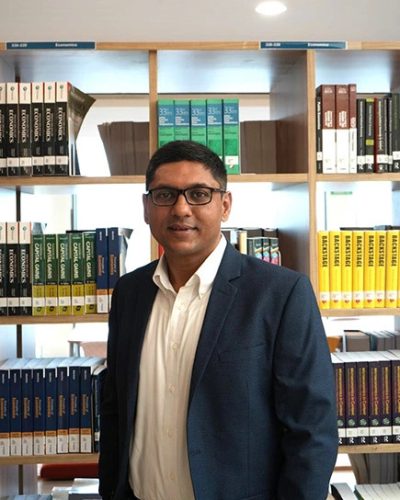
Prof. Parasuram Balasubramanian
Ask an academic what writing a paper actually involves, and you will likely get an unromantic response. Perhaps a tenth of the effort goes into the idea and the argument. Much of the effort lies in finding a suitable dataset for the research question, extracting data from websites or PDF files, merging and appending across data sources, or redrawing a figure for the ninth time. Over the past eighteen months, AI tools such as Claude and ChatGPT have been absorbing much of that effort, by not only providing code, but actually executing code and generating results.
Built for coders, I have been using Claude Code from Anthropic. Claude Code is an agentic tool that reads my project folder, analyses datasets, writes and debugs code in STATA and Python, and can be fine-tuned for specific research purposes. Claude Cowork carries the same idea into work involving no code: reading through a stack of PDFs, reconciling spreadsheets, turning scattered notes into a first draft.
Anthropic’s own usage figures suggest this is the dominant use. I recently used Claude Science to cleanly scrape data from a database of clinical trials, and from a large database of publications from PubMed based on a few simple prompts. Claude Science is an AI workbench app for medicine and life science, with integrated tools, databases and compute management in an agentic environment. Assuming moderate proficiency in coding, this task would have taken me at least a week to pull off manually on Python. Claude Science will not only boost research potential but help address reproducibility in the sciences.
This matters more here in India than elsewhere. Much of our source data arrives as scanned reports, spreadsheets built for printing rather than analysis, and surveys whose categories or classifications often shift between rounds. That friction has always been a quiet tax on research done in the Indian context, and anything that lowers this friction is beneficial for researchers. It would be a mistake to read this as work getting easier.
Two things are happening at once. One, coding ability, for long a real barrier to entry, and a quiet advantage for those who had it, is being commoditised. A student who cannot write a line of code can now run an analysis that would once have taken a skilled researcher programmer a week or two. Two, the bar for analysis and causal inference has also risen, now that more researchers can easily run sophisticated models.
What is left is judgement. The same AI tools are confidently wrong often enough, that no AI output should go unchecked. Technical execution used to separate good empirical research from the mediocre. Increasingly it is only the price of admission. For researchers, that is a good trade. I suspect it is the same trade your analytics teams are making right now.