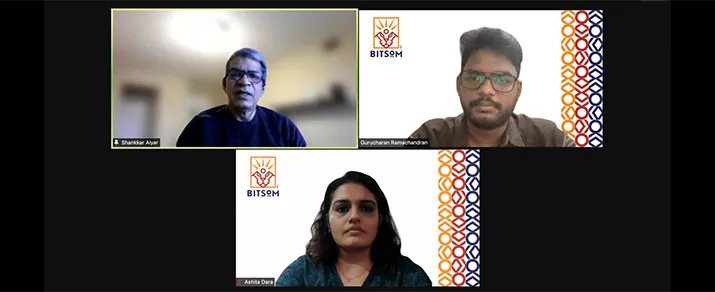
BEING A PART OF THE DESIGN - PROF. SHANKKAR AIYAR IN CONVERSATION WITH GURUCHARAN R
by Gurucharan R Apr 20th, 2022
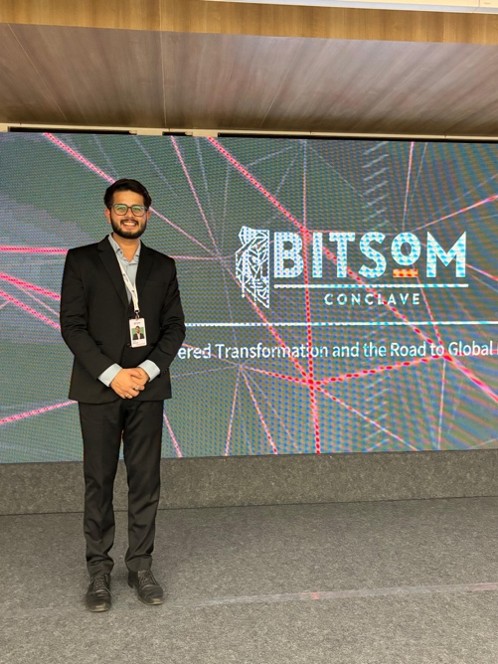
This is a transcript of Prof Shankkar Aiyar’s interview by our founding class student, Gurucharan. Prof Shankkar Aiyar is a prominent India-based political economy analyst, columnist, and author. He is a visiting faculty at BITSoM and teaches Politonomics
What are three main public policy challenges for India in the upcoming decade?
Decision making. Collaboration. & Being a part of the Design.
Economics doesn’t operate in a vacuum, and similarly, business models don’t. Being future leaders, management students like the ones in BITSoM need to know the political and economical landscape to make business decisions. Every business model operates in a social, political, and economic circumstance, hence these are factors of consideration while crafting a business plan or deciding to expand an existing business.
The principal point as to needing to understand public policy is the underlying question, ‘How can business leaders be contributors to economic growth?’. With economic growth, the purchasing power of the population increases, and thereby the expansion potential of the businesses become large, serving in the interest of the business. Therefore to build an effective and better economy, there needs to be a collaboration of interests and ideas. Taking the example of Japan, the economic success can be significantly attributed to the small and medium level industries given the task and expanding the export potential.
“Public policy is the mechanism with which governments create legislative and regulatory frameworks for businesses to operate in it. Unless business leaders participate in it, they will be left out of the design. This necessarily isn’t lobbying, but the way public policy is crafted across the world in developed economies where there is collaborative participation between economic and political forces.”
What are three main public policy challenges for India in the upcoming decade?
Deepening Pockets. Turning the Skill Tide. & Addressing Asymmetry
The biggest challenge is to expand the footprint of purchasing power, i.e, to expand the incomes of people to become active consumers in the market. This has utmost relevance to business professionals as they either run businesses or create new ones with the same intent.
The second challenge arises once one starts running a company, where one needs people to run effectively. Hence talent acquisition and skilling occupy are a priority. The challenge starts at the induction level from understanding what kind of talent is required and meeting the expected quality of recruits to handling ups and downs due to disruptions and dealing with them as a business.
In order to turn the tide in one’s favor, a business should attempt partnering with government, public institutions, or philanthropic organizations and creating a platform for skilling, reskilling and upskilling.
Figuring a way to even the asymmetry of opportunity, employment, income is the third big challenge for business and the economy. Ie. Finding a way to enable those who have lost and to support them, while simultaneously analyzing ways to propel growth. The unevenness of the income paradigm that currently exists has to be managed and eventually controlled and it will assuredly stare at the business plans of several companies. For example, digitization and automation in the financial sector have led to the desertification of ATMs by the current generation, leading to a reduction in the human interface requirement. The only way to resolve this is to find a balance between the pain and the gain that accelerated economic growth brings
Why is there a tension between policy makers and business leaders, and do you navigate through it?
Interacting through the Strategic Tension
The existence of strategic tension between those who frame public policy and those who manage businesses is a permanent phenomenon.Businesses by nature require centralized processes, faster and speedy clearances, less friction, require the government to facilitate the efficiency of scale, distribution, talent acquisition, and maintain social harmony. The government on the other hand expects the businesses to pay for their expectations and shoulder a part in the expansion of economic growth, creating jobs, pushing investment, etc. The more they interact, the better the tension will be managed and inclusive growth can be attained.
Gurucharan Ramachandran MBA Class of 2023 (the Founding Class)
You will now receive an email to verify your Email ID.
Once email ID is verified, you will receive another email with your Login ID and to set your password for Student Dashboard to start your application.
Within next 3 business days, our admissions counsellor will call you from a Truecaller verified number.
In case of any urgent queries, you can call +91 8050012004 or write to us at admissions@bitsom.edu.in
Thank You for Registering!
You will now receive an email to verify your Email ID.
Once email ID is verified, you will receive another email with your Login ID and to set your password for Student Dashboard to start your application.
Within next 3 business days, our admissions counsellor will call you from a Truecaller verified number.
In case of any urgent queries, you can call +91 8050012004 or write to us at admissions@bitsom.edu.in
Download Brochure
Thank you for registering with the BITS School of Management.
Our admission cycle is closed now for A.Y. 2024-2025. We are not accepting any new applications for now.
Our counselors will reach out to you if there are any further updates about your application.
In case of any urgent queries, you can call +91 8050012004 or write to us at admissions@bitsom.edu.in
Request Callback
Thank you for registering with the BITS School of Management.
Our admission cycle is closed now for A.Y. 2024-2025. We are not accepting any new applications for now.
Our counselors will reach out to you if there are any further updates about your application.
In case of any urgent queries, you can call +91 8050012004 or write to us at admissions@bitsom.edu.in